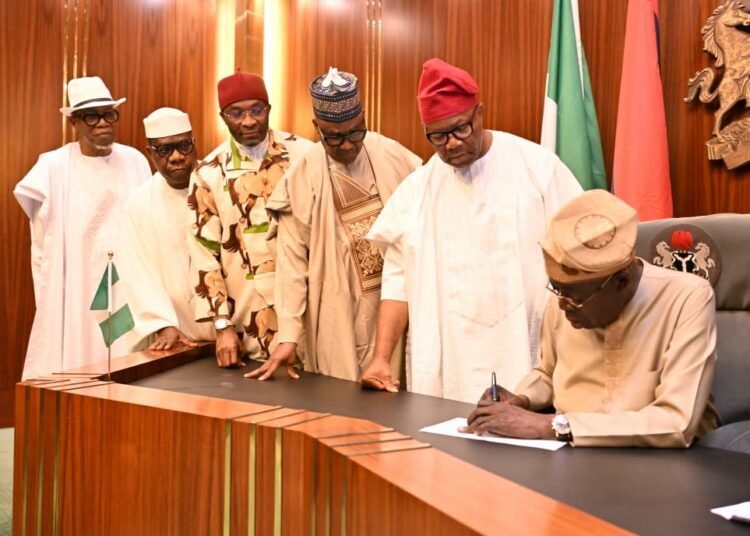



The recent increase in electricity tariffs, sanctioned by the Nigerian government, has drawn the ire of many Nigerians, and rightly so. In an attempt to ward off criticism of the increase at a time of unprecedented hardship over the cost of living, the Nigerian government and its strategists claim that the increase is basically for the elites, otherwise tagged ‘Band A’ consumers. The increase, about 300 percent, was therefore aimed at dividing consumers along income lines.


But this excuse immediately falls like a pack of cards when examined, even in its face value. The use of the band system as a way of supplying and surcharging consumers is a form of economic apartheid. Giving a certain percentage of the population longer hours of electricity supply because of their ability to pay is not only illegitimate and unjust but also anti-development. It clearly gives the electricity companies (Discos and Gencos) an alibi to avoid improving facilities, production and supply since their profits are guaranteed by a certain layer of consumers. That the government will back this policy shows whose interests the government protects. It is one thing to give some priority to certain critical sectors, such as public institutions (health, education, security, etc.) and important economic sectors, at a time of limited production and supply; it is another thing to segregate consumers on the basis of their ability to pay more. Even such a policy of prioritizing critical sectors will only be a temporary and short-term one and not a permanent one, upon which all other policies will be based.
Secondly, the idea that the tariff increase is only meant for those who can afford it betrays the real intention of the policy. There is no demographic data to show that poor and working-class people do not live in areas designated as ‘Band A’. Even if the increase will affect only the upper middle class and big businesses, simple economics made us understand that this will be transferred to other social and economic strata, especially the working class and the poor. More than this, the increase is only a dress rehearsal for an increase across the board because the same argument used to justify the latest increase applies to other categories of customers, only that the government wanted to test the water with ‘Band A’. It is not a new strategy.
But one of the major planks of this write-up is the argument for the increase: the need to end electricity subsidies and allow for cost- or market-reflective tariffs. This is flowing from the idea that subsidy is altogether bad and market fundamentals must not be interfered with. This is coming from the Structural Adjustment Programmes of the Bretton Woods institutions, which are actually in the service of global finance capital, the controlling arm of global capitalism. Yet, the most advanced economies and fast developing economies actually implement huge subsidy programmes across sectors to sustain the status of their economies or to move them forward. Even if a great part of these subsidies goes to the rich class, a large percentage is still directed towards expanding their economies.
Developing countries, which mostly depend on primary product extraction, are told to avoid all subsidies, even when they are important for spurring their economies towards development and human development. Indeed, the best era of improvement in human and economic development for developed economies happened when the state directly intervened in the economy through essential subsidies, investment in important economic sectors, and human development, curtailing the excesses of the capitalist class and not excusing them as presently witnessed.
Rather, what you have is a continuous increase in tariffs almost every year. Meanwhile, there is hardly any improvement in facilities, electricity infrastructure, or installations. All the distribution companies (Discos), generating companies (Gencos) and even government-owned Transmission Company of Nigeria (TCN) are short-staffed such that it will sometimes take days to effect repairs in damaged facilities. There are no investments in modern equipment to limit electricity loss and theft. On the other hand, consumers are made to shoulder the responsibility of supposed private companies, including paying exorbitantly for prepaid meters, subsidizing the revenue shortfall of discos through outrageous estimated bills and paying for the repair of electrical installations (e.g., transformers).
Worse still, the same government that was talking about ending subsidies on electricity has given tens of billions of naira in dole-outs and financial support to the Gencos and Discos. An interesting fact is that the Nigerian government still has a substantial share in the ownership of Discos and some of the Gencos. Yet, while the private majority shareholders are making profits and using government funds to pay off bank loans, the government, as a minority shareholder, cannot point to any gain or profit accrued to the public from these companies. Rather, the same government is not only giving billions of public funds to bail out private businesses, but it is also helping them to milk Nigerians dry through a continuous tariff hike. The Nigerian Electricity Regulatory Commission (NERC), which is supposed to defend public interests, serves more the interests of Gencos and Discos, who want to make huge profits with little or no investment.
Furthermore, the failure of the government to fund alternative power generation and supply, especially through solar and wind energy, is part of the agenda to protect the profits of private businesses in the power supply network. If the government embarks on a policy to power all public institutions with solar and wind power supply systems, this will reduce, in the medium and long term, government expenditure, reliance on crude oil and fossil fuels, and rapidly increase renewable power supply uptake across the country. By directly funding production and installation factories for renewable power and establishing research centres/institutes for renewable energy, a new clean energy economy will be created that will have multiplier effects on the economy.
A deliberate focus on investment in stand-alone and non-grid renewable power for rural homes, low-income earners, and workers (whose income is fixed) who spend a significant share of their income on energy, will reduce the cost of living and poverty, and further spur the economy as more disposable income will be available for other needs. This will also reduce pressure on existing traditional electricity capacity, and compel private electricity companies (Discos and Gencos) to be more responsible and competitive. But the Nigerian pro-capitalist government will not do this because it is not in the handbook given to them by the masters in the Bretton Woods institutions.
Ultimately, guaranteeing constant and affordable electricity will require the Nigerian state to put the power sector under public ownership with democratic and accountable management. The current failure of the private-sector-led power sector makes this more obvious than ever. But the biggest task is for the trade union movement to push genuine pro-people energy policies. It is in the interests of the working class to ensure that economic policies reduce the cost of living and increase living standards while narrowing the wealth gap and reducing inequality. This cannot be done through mere advocacy but as a cardinal aspect of trade union principles and agitations.
*Ibrahim, an author and Climate Justice campaigner, writes from Ile- Ife, Osun State (08059399178, kmarx4life@gmail.com)