

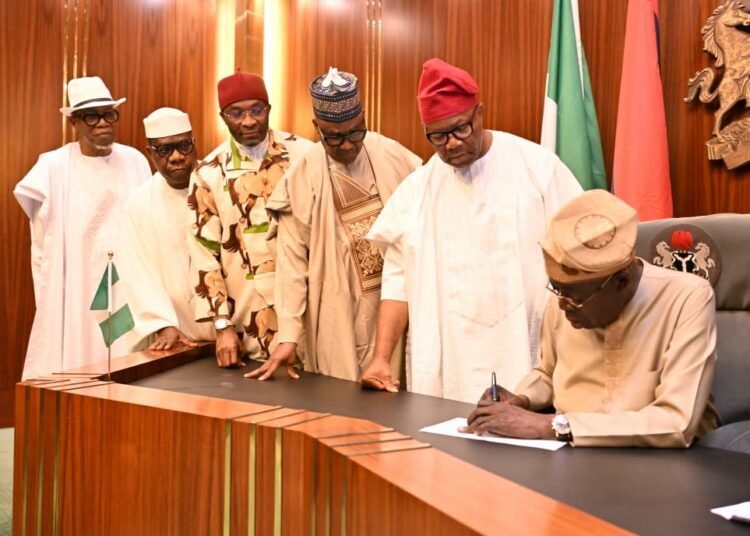
President Bola Tinubu has signed into law the Electoral Act 2022 (Repeal and Re-enactment) Bill 2026, declaring that Nigeria’s electoral process remains “essentially manual” despite new provisions recognising electronic viewing of results.

The signing ceremony, held at the Presidential Villa in Abuja on Wednesday evening, was witnessed by the leadership of the National Assembly, including Senate President Godswill Akpabio and Speaker of the House of Representatives Tajudeen Abbas.
In his remarks, President Tinubu emphasised that the overriding objective of the amendments was to guarantee clarity in the electoral process and safeguard Nigerians from disenfranchisement.
“It’s not as important as the history aspect of this, what is crucial is the fact that you managed the process to the extent there will be no confusion, no disenfranchisement of Nigerians, and that we are all going to see democracy flourish,” the President said.
He maintained that, notwithstanding technological improvements, elections in Nigeria are conducted and concluded by human beings.
“No matter how good a system is, it’s managed by the people… In fact, for final results, you are not going to be talking to the computer, you are going to be talking to human beings, who’ll announce the results,” Tinubu noted.
Electoral Reform: Protesters Stay Off National Assembly After Reps Align With Senate On Result Transmission
The President stressed that the act of voting remains manual.

“As long as you appear personally as a manual voter in any polling booth, ballot paper is given to you manually… ballots are subsequently counted manually, sorted and counted manually… It’s still manually, essentially,” he said.
Raising concerns about infrastructure, Tinubu questioned the country’s broadband capacity and readiness for seamless real-time electronic transmission of results.
“When you look at the crux of various arguments, maybe, Nigeria should question our broadband capability. How technically are we today? How technically will we be tomorrow?” he asked.
He warned against technological disruptions and cyber threats, stating: “The transmission of that manual result is what we’re looking at, and we need to avoid glitches… interference, unnecessary hacking in this age of computer inquisitiveness.”
Speaking after the signing, Senate President Akpabio described the amendments as thorough and reflective of Nigeria’s peculiarities.
“A lot of provisions in the amended Act will definitely make Nigerians very happy. We did a very thorough job, very painstaking. We took cognizance of the peculiarities of the country,” he said.
Akpabio disclosed that the amended law legally recognises the Independent National Electoral Commission’s Result Viewing (IReV) portal to enable electronic viewing of polling unit results.
“All Nigerians wanted was that in the IReV portal, which is a kind of viewing center for polling unit results, they would like to see those results transmitted electronically. We have included that in the amendment just signed into law,” he stated.
He explained that the law also makes provision for areas without network coverage by recognising Form EC8A, signed at the polling unit by the presiding officer, party agents and security personnel, as the primary source of collation.
“Even if there’s no network at that time, once we step out toward the ward or local government center, it will drop into the IReV, and people will still be able to view it,” Akpabio said.
According to him, the new framework addresses what he described as Nigeria’s historic challenge of result tampering.
“That has always been the problem in our country: once an election result leaves a polling unit, it gets tampered with or mutilated. That has been eliminated today,” he added.
On his part, Speaker Abbas highlighted the reduction of the statutory notice period for elections from 360 days to 300 days.
“The number of days’ notice was 360 days in the 2022 Act. Now we have seen the wisdom to reduce it to 300 days,” Abbas said.
He noted that the adjustment could allow presidential and National Assembly elections to hold in January 2027.
“This will inadvertently allow holding the presidential and National Assembly elections in January 2027, technically avoiding elections during Ramadan 2027 to avoid voter apathy in the next general election,” he stated.
By Ngozi Ibe @LEADERSHIP