

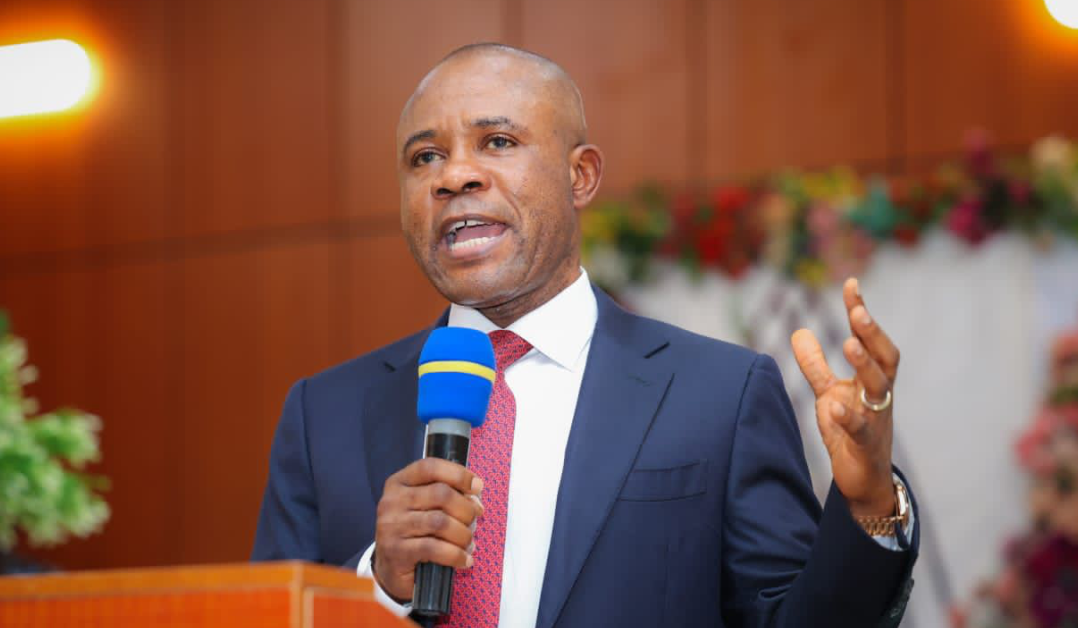
Enugu’s Secretary to State Government, SSG, Prof Chidiebere Onyia, has said the education policy of the present administration was geared towards contributing to the bio-digital-technology that would drive the fourth industrial revolution across the globe through the introduction of innovative technologies in education, particularly in basic education system.

Onyia, in his keynote address, titled “Smart Basic Education and the Future of Africa” delivered at a quadrennial convention organised by Union Secondary School, Awkunanaw Enugu Old Boys Association, UNISSOBA, in Enugu yesterday, said the administration of Governor Peter Mbah has taken some deliberate steps at reforming the education system to meet the much needed changing global demands.
He noted that with the African continent constituting the world’s youngest and largest population, compared with other continents with declining and ageing populations, it had the greatest human capital opportunity and future talent pool with enormous opportunities.
He, however, expressed regret that the continent was lagging behind in terms of quality education with a high rate of schooling and learning poverty rate, which could rob the continent of the emerging future opportunities.
Onyia said: “We recently conducted a Baseline Assessment of our primary schools in Enugu State in November 2023. Our findings were shocking. After four years of primary schooling, 50% of our children cannot read a single word in English.
‘’Those who can read struggle with comprehension. After six years of primary schooling, 50 per cent of our children cannot solve simple subtraction challenges. What we found out in Enugu State is writ large across our nation.
“In Nigeria, three out of four children who complete basic education lack numeracy and literacy proficiency. The World Bank, UNICEF, and UNESCO have defined this as ‘the Nigerian Learning Crisis.’
‘’On top of this, our children suffer a ‘skills gap’ because existing modes of teaching do not equip children with scientific, technological, productive, and digital competences.’’
He expressed optimism that the challenges were being addressed by the well-thought out radical policy-initiatives by the state government, which would not only equip students with emerging future technological skills, but also afford them opportunities to compete with their peers globally.
The SSG explained that with the introduction of the smart school model across the 260 electoral wards in the state, which has new facilities such as the centre for artificial intelligence, interactive smart boards, centre for robotics, among others, the state was set to lead in the fourth industrial revolution.
He added that the academic curricula would now emphasize on experiential learning methods, problem-solving and case studies.
Source -Vanguard